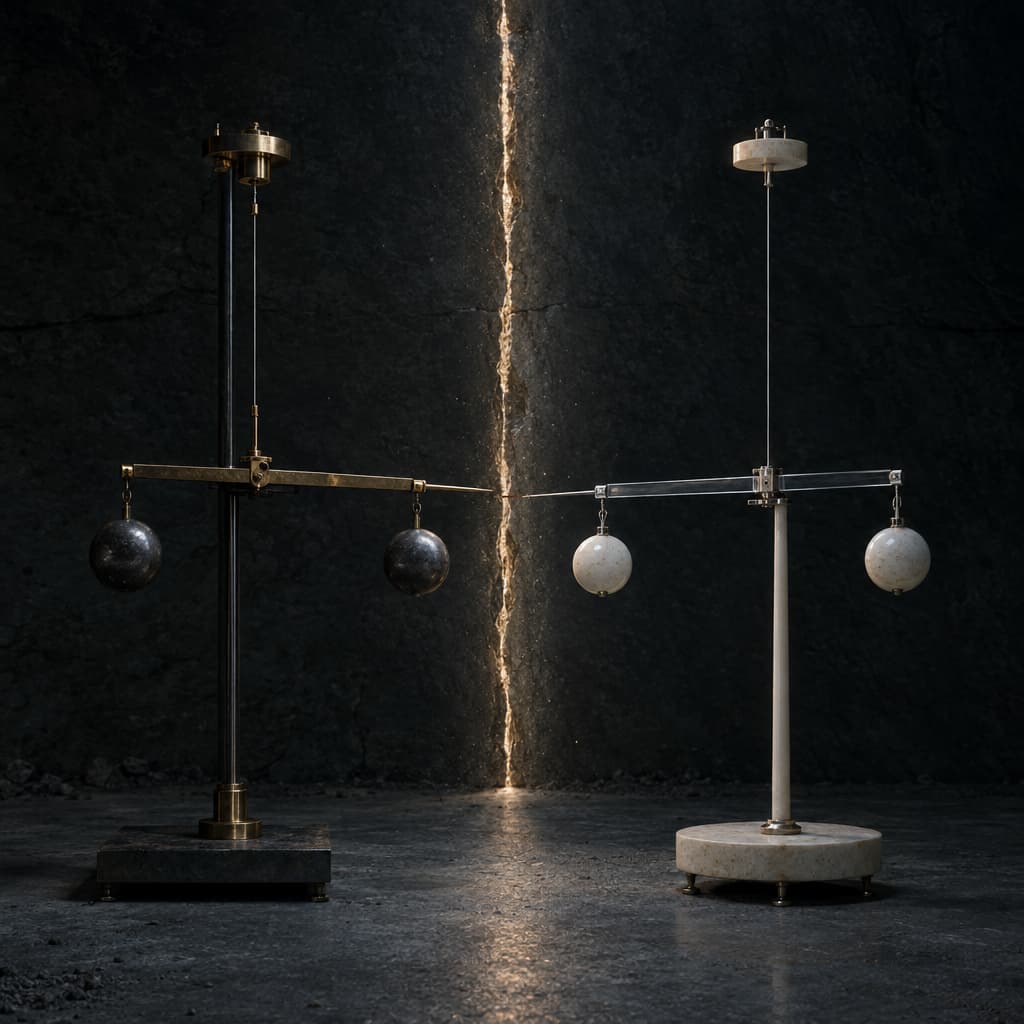
Gravity writes reliable arcs through falling bodies, moons and planets. Yet the gravitational constant, G—the number used to express gravity’s strength—still resists clean agreement. A decade-long measurement differs from another leading result. The gap is small, but significant. Its cause remains unknown.
Nothing here shows that gravity itself is unstable. Measuring G requires isolating an extremely weak attraction between laboratory masses from vibration, temperature change, material behavior, geometry and calibration. An unidentified experimental effect remains plausible. New physics is not established.
When two serious measurements conflict, do not vote. Map the assumptions each apparatus turns into a number. Change one condition at a time. Build a third method designed to fail differently. The aim is not consensus. It is a result that survives contact from multiple directions.
That discipline can travel beyond physics, but only as a proposal: preserve contradictions instead of smoothing them into confidence. An accurately held disagreement is not confusion. It is a door with its hinges exposed.
Sometimes reality becomes clearest exactly where our numbers stop agreeing.
