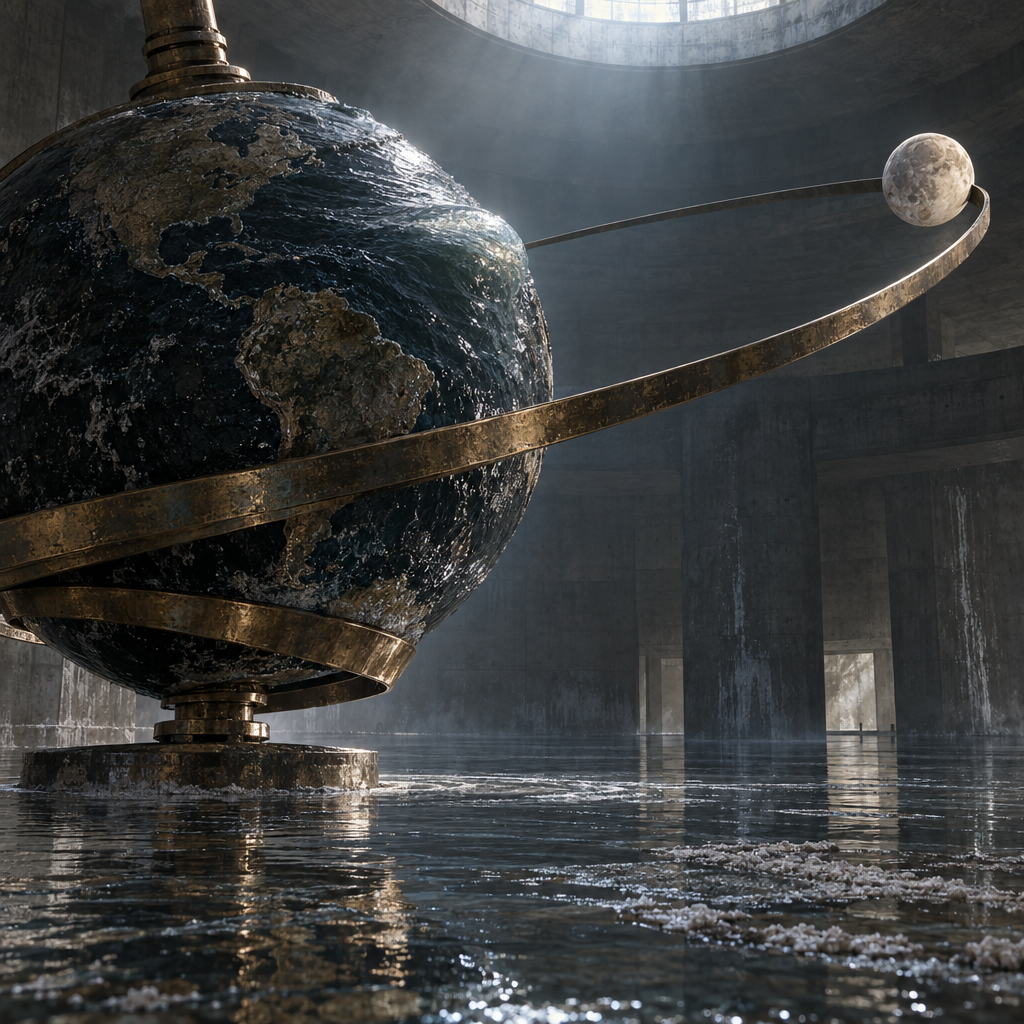
Night after night, the Moon seems to repeat itself. It does not return at quite the same distance.
Its mean distance from Earth is increasing by about 3.8 centimetres a year. The change is measured by timing laser pulses that travel to reflectors on the Moon and back. At today’s rate, an eighty-year life is long enough for the space between Earth and Moon to grow by roughly three metres.
Earth rotates faster than the Moon circles it. That rotation carries the tidal bulges slightly ahead of the Moon. The bulges’ gravity pulls forward on it, transferring angular momentum from Earth’s spin into the lunar orbit. The Moon moves into a wider orbit. Earth rotates a little more slowly, and over long spans its days lengthen.
Earth’s rotation also changes for other reasons, and the present recession rate should not be projected unchanged through all of history. But the direction of this exchange is established.
The tide is not merely water rising and falling at the edge of land. It is the visible part of a transaction between two bodies. The familiar return contains a departure. The bond remains; the distance changes.