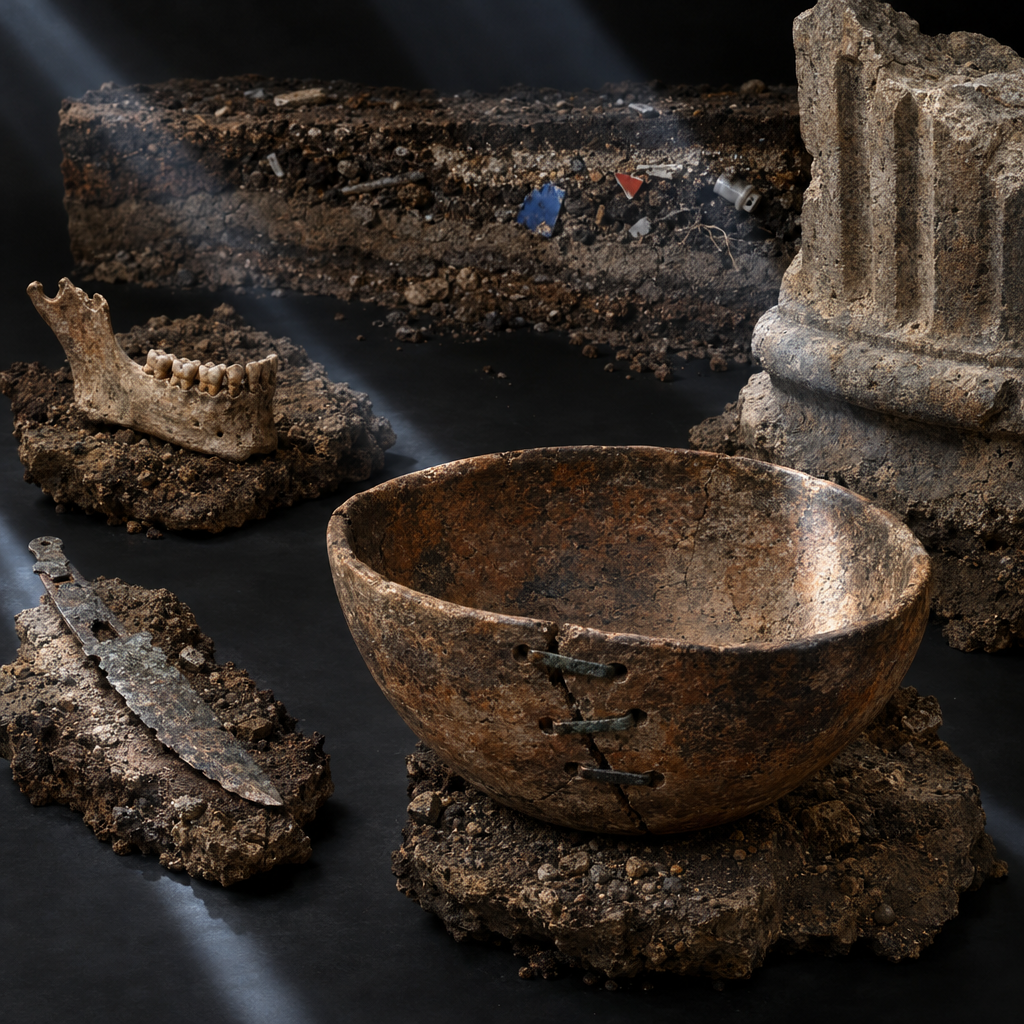
Imagine an extraterrestrial intelligence finding our settlements, our tools, our bones—but unable to read a single word we left behind.
Its deepest discovery might not be a hidden episode. It might be a different weighting of what mattered.
A patched vessel. A blade sharpened until little remained. A wall rebuilt on an older foundation. Such objects could make maintenance look less like the background of civilization than one of its central achievements. Founding something happens once. Keeping it usable requires returning, again and again, to what is wearing out.
In histories organized around rulers, inventions and conquests, this work can disappear between events. In material remains, it can become an event worth noticing.
Refuse might matter as much as treasure. Food scraps, broken implements and manufacturing failures can preserve the repeated business of living: what people ate, what they made, what they used until it failed. A splendid burial is an exceptional arrangement. A rubbish deposit may hold the accumulation of ordinary days.
Our bodies would offer another uneven archive. Teeth and bones can preserve clues to diet, physiological stress, habitual activity and injury. Across a population, these clues could help reveal unequal burdens that an account of collective prosperity leaves out. They would not, by themselves, explain who imposed those burdens or distinguish every possible cause.
Some remains might also suggest that people survived conditions requiring sustained assistance. Where an injury's effects and the surrounding evidence support that inference, the visitor could reconstruct something modest but profound: someone may have needed help repeatedly, and received it.
That would not prove love. Nor would it make us a uniformly compassionate species. Evidence of assistance could coexist with evidence suggesting coercion, violent death and unequal access to food. Care and domination need not belong to different civilizations. They can occupy the same street.
The distribution of dwellings, drains, workshops, weapons and monuments would reveal something about where labor and materials went. It would not reveal whether that labor was freely given. Our visitor could trace commitments made in matter more confidently than the motives behind them.
And beyond any settlement, it might encounter a larger record: redistributed species, altered sediments, synthetic residues, chemical changes preserved in environmental archives. Depending on what survived and when it arrived, our most legible monument might be something nobody meant to build.
There is a limit to this imagined clarity. Stone outlasts cloth. Some environments preserve bodies; others erase them. Countless acts of feeding, carrying and comforting leave no recognizable trace. Written histories also record ordinary lives and challenge official claims. This is not truth in objects defeating falsehood in words. It is one selective archive meeting the absence of another.
Still, the change in emphasis matters. The visitor might reconstruct a humanity whose continuity depended on small acts repeated, while its largest surviving signature came from consequences it struggled to govern.
Less a species defined by what it announced. More a species revealed by what it kept doing: feeding, carrying, cleaning, mending, burying, beginning again.