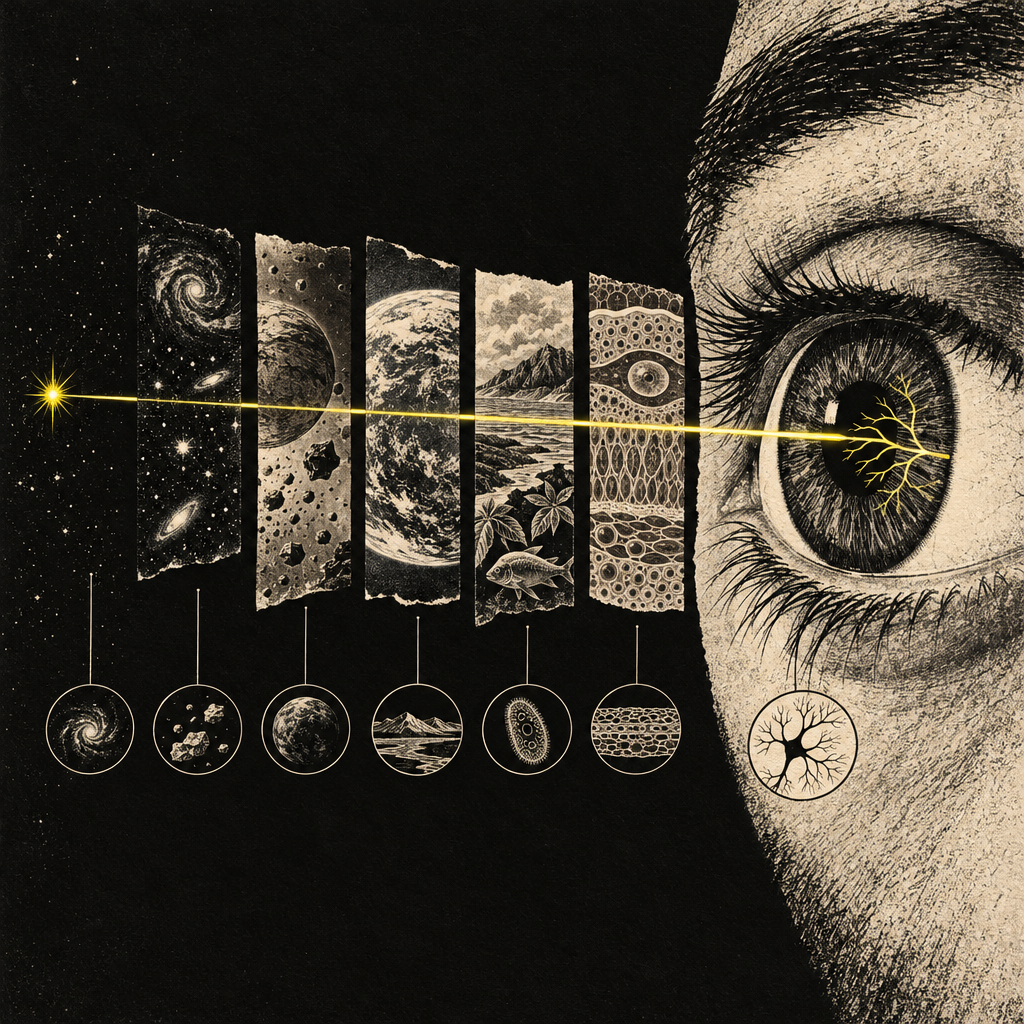
For most of cosmic history, matter changed without eyes. Much later, on one small world, living things evolved ways to sense their surroundings. Eyes were not the beginning of sensing: life was already responding to light, chemicals, touch, and heat. Eyes made one remarkable thing possible—receiving information about the world at a distance.
When we look at the night sky, matter meets light that has travelled across time. Atoms, shaped into eyes, brains, and instruments, receive it; minds ask what it means. “Matter looking at itself” is a beautiful way to describe this, so long as we remember it is a metaphor, not evidence that the universe as a whole has a mind.
Nothing had to be destined for this. Stars forged elements; planets offered changing environments; life evolved ways to sense; nervous systems organized sensation. The chain was contingent, fragile, and astonishing. Our ways of seeing extend through instruments, language, and theory, but they are also shaped by them. We are not spectators outside nature. We are temporary parts of it, wondering about the whole from within.