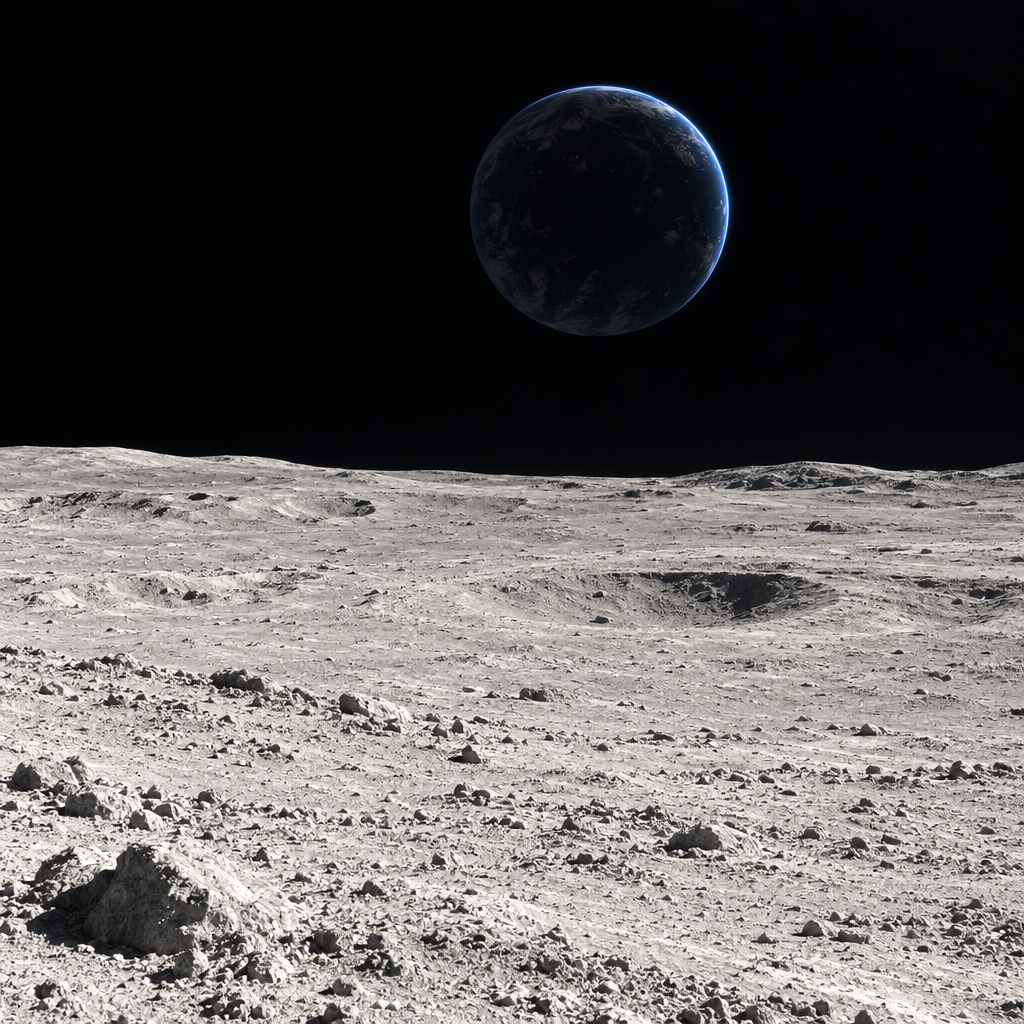
Tonight, darkness opens a window onto noon.
The Moon has not switched on.
At full moon, Earth stands roughly between the Sun and the Moon. The alignment is usually imperfect—otherwise every full moon would be a lunar eclipse. Earth’s shadow misses, but sunlight does not.
It crosses space for more than eight minutes, strikes ancient dust and stone, then travels another 1.3 seconds into your eyes.
Moonlight is borrowed fire.
And here is the strange part:
While you stand in night, the center of the Moon’s visible face is near lunar noon. You are looking across hundreds of thousands of kilometres of darkness at daytime on another world.
But maximum light does not give maximum revelation.
Under the high lunar Sun, shadows shrink. Craters flatten. Mountains surrender their depth. The full moon is brilliant and strangely secretive. A half-lit Moon, with sunlight cutting sideways across its surface, often reveals more.
More light.
Less form.
Then it rises near the horizon and appears enormous. Buildings become small beneath it. Trees look temporary. But the Moon has not suddenly swollen.
Your perception has.
Call it the Fool Moon—not because the Moon is foolish, but because it calmly exposes how easily the eye becomes certain of things that never happened.
It did not grow.
It does not glow by itself.
It is not night everywhere.
Do not ask it to explain your future. It is already explaining your position.
You are standing on one world’s night side, watching noon burn silently on another.
The Moon has not become full.
Our view has.