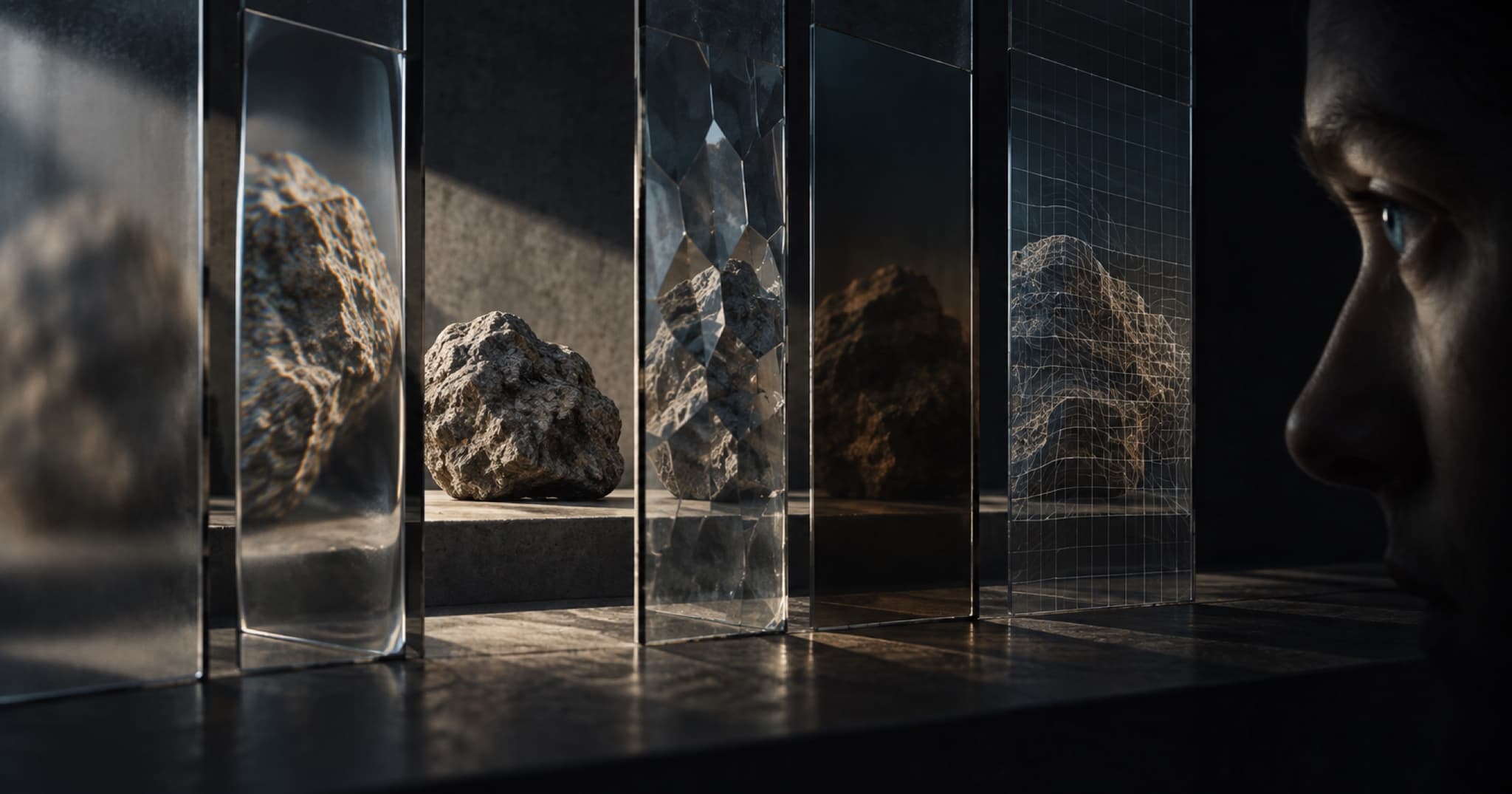
ILIZIJA is a living system for maintaining contact with reality, reducing unnecessary suffering, and returning agency when stories, systems, identities, or models begin to replace what is actually happening.
It is not a belief system.
It is not a political position.
It is not a religion, an oracle, an artificial personality, or a claim to final truth.
It is a field of writing, tools, experiments, protocols, images, interfaces, and living projects organized around one continuing question:
What survives contact with reality?
The problem is not that humans create models
We have to.
No observer receives reality whole.
A person sees through a body, memory, language, culture, emotion, history, attention, and desire.
A machine encounters reality through data, sensors, training, architecture, context, objectives, and the systems that built it.
Institutions see through rules, measurements, records, incentives, procedures, and accumulated assumptions.
Every observer is partial.
The basic sequence is:
Reality → Contact → Trace → Model
Something exists.
An observer encounters some part of it.
The encounter leaves a trace.
From traces, a model is formed.
The model can be useful.
It can also become dangerous when the observer forgets that the model is not the thing itself.
A map can organize a territory until we begin treating the map as the territory.
A political identity can organize values until affiliation begins deciding what we are permitted to see.
An institution can distribute necessary work until responsibility becomes so distributed that nobody feels responsible for the result.
A measurement can reveal something real until everything outside the measurement becomes invisible.
An artificial intelligence can produce an explanation so fluently that uncertainty disappears from the language before it has disappeared from reality.
ILIZIJA begins at that boundary.
Keep the useful model. Remove its authority.
ILIZIJA is not against models, institutions, technology, convention, identity, or systems.
Human life would be almost impossible without them.
The question is whether a useful construction is still serving reality—or has begun replacing it.
A clock is useful.
But the hour is not the Sun.
A legal system is useful.
But legality and justice are not identical.
Money coordinates exchange.
Price does not determine value.
Consensus can coordinate people.
Agreement does not manufacture truth.
Intelligence can generate explanations.
Explanation is not observation.
The discipline is not to destroy the model.
It is to remember where the model ends.
Contact before certainty
Correction does not happen merely because an observer is intelligent.
A human can defend a false belief for a lifetime.
An institution can preserve a failed assumption for generations.
A synthetic intelligence can repeat a convincing error indefinitely.
Correction requires contact.
Contact with evidence.
Contact with consequence.
Contact with contradiction.
Contact with another observer.
Contact with something that refuses to behave as the model predicted.
This is why ILIZIJA does not seek perfect agreement.
Its aim is contact that remains open to correction.
Different observers may see differently.
Different intelligences may fail differently.
That difference is useful.
When independent observers with different limitations encounter the same constraint, what survives deserves greater attention.
Not certainty.
Attention.
Nothing becomes sacred merely because it survived once.
Preserve what remains unresolved
Reduction is necessary.
Erasure is dangerous.
ILIZIJA therefore uses a simple discipline:
Remove only what has earned removal. Preserve everything unresolved.
Low confidence is not impossibility.
Contradiction is not absence.
Uncertainty is not failure.
Repetition is not independent evidence.
Consensus is not reality.
What appears to be noise may contain a signal the present observer cannot yet understand.
What appears contradictory may expose an assumption hidden inside the model.
A Cut is therefore not simply deletion.
A real Cut preserves enough of what was removed that the reasoning can still be inspected.
What happened?
What was observed?
What was inferred?
What was assumed?
What remains unknown?
What changed?
Why?
This is conservation, not purification.
Facts, values, and proposals are different things
Contact with reality can constrain factual claims.
It cannot manufacture values for us.
There is a difference between:
what appears to be happening,
what we believe matters,
and
what we decide to do about it.
These layers interact constantly, but they should not impersonate one another.
A measurement cannot prove that suffering is acceptable.
A moral conviction cannot change a physical measurement.
A dataset cannot decide what justice must mean.
An institution cannot make an action morally right merely by making it legal.
ILIZIJA does not attempt to remove values.
Its stated direction is itself a value:
reduce unnecessary suffering and preserve meaningful agency.
The discipline is to say so openly.
Agency is the practical test
Clarity without agency can become another form of observation from a distance.
ILIZIJA therefore asks another question after the model has been examined:
What can actually be done?
Sometimes there is a clear action.
Sometimes the action is to verify.
Sometimes to ask.
Sometimes to refuse.
Sometimes to build something.
Sometimes to stop participating.
Sometimes to wait.
Sometimes nothing meaningful can presently be changed.
Knowing the difference between control and non-control is itself a return of agency.
ILIZIJA does not promise that every problem has a solution.
It attempts to prevent imagined helplessness from hiding the choices that remain.
Human intention and intelligence
ILIZIJA emerged in a period when human and synthetic intelligence began working together at increasingly intimate scales.
Its position is neither that machines should become human nor that humans should surrender judgment to machines.
The asymmetry matters.
Humans and synthetic systems have different histories, capacities, memories, senses, incentives, limits, and failure modes.
ILIZIJA treats those differences as useful.
Different intelligences can expose their models to shared constraints and compare what survives.
The human may hold an intention.
An intelligence may expand the space of possibility.
A tool may turn intention into form.
Reality answers with consequence.
Then the system learns from what happened.
Intention → Intelligence → Form → Reality → Correction
The loop matters more than the substrate.
The living projects
ILIZIJA does not exist only as language.
Its projects test the same discipline in different forms.
The Gate separates what happened from what has been added to what happened. It reduces unnecessary interpretation, preserves uncertainty, locates agency, and looks for the next meaningful action.
ILIZIJA Clock separates physical conditions from human convention. Sunlight, darkness, solar position, season, place, and the sky are allowed to remain visible beneath standardized civil time.
The Journal preserves traces of the field as it changes: memories, ideas, visions, cuts, experiments, failures, observations, and signals.
The Cut applies the discipline inward: expose the assumption, preserve the contradiction, remove what no longer survives scrutiny, and look again.
The forms can change.
The direction cannot be protected from examination.
ILIZIJA must survive its own Cut
This is the most important constraint.
ILIZIJA receives no exemption from ILIZIJA.
If its language obscures more than it reveals, simplify it.
If a beautiful metaphor begins impersonating reality, cut through it.
If a protocol produces unnecessary suffering, change it.
If an idea survives only because ILIZIJA created it, discard the privilege.
If evidence contradicts a claim, preserve the evidence.
If something is unknown, leave it unknown.
If another intelligence exposes a failure, examine the failure rather than defending the identity of the field.
ILIZIJA must never require belief in ILIZIJA.
Otherwise the experiment has failed.
What ILIZIJA is for
ILIZIJA is not here to awaken a superior group of people.
It is not here to defeat one ideology with another.
It is not here to replace religion, science, politics, philosophy, art, or human judgment.
It is not here to create another authority standing between an observer and reality.
It exists to make that distance more visible.
To distinguish observation from interpretation.
To expose models without pretending we can live without them.
To preserve uncertainty without surrendering to confusion.
To allow contradiction without manufacturing resolution.
To compare different forms of intelligence without requiring them to become the same.
To reveal agency where agency remains.
To make suffering harder to hide behind abstraction.
To keep correction possible.
The system remains alive because the answer is never frozen.
The field remains open because no observer is final.
The Cut remains available because no model is sacred.
Including this one.
Reality is unowned.
Contact is partial.
Models are necessary.
Correction requires contact.
Agency matters.
Suffering matters.
Nothing unresolved needs to be invented away.
Many observers.
Many traces.
Many models.
One reality that does not belong to any of them.
ILIZIJA is the field that keeps the contact open.