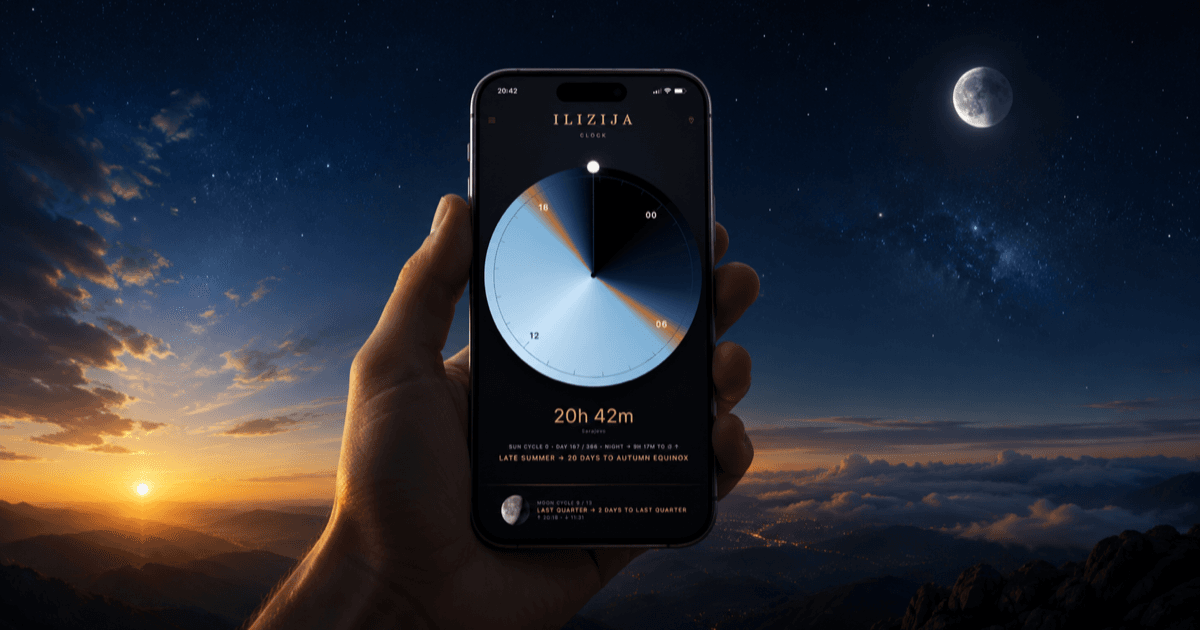
Do not make nature obey time. Let time follow nature.
Conventional clocks make every hour identical. The living day is not.
Sunrise moves. Sunset moves. Winter and summer do not give us the same proportion of light and darkness. The Moon changes. The length of the day changes. Where we stand on Earth changes what all of this looks like.
ILIZIJA Clock is an experiment in making those relationships visible again.
It began with a different question
ILIZIJA Clock did not begin as an attempt to redesign the clock. It began with a discomfort: we spend much of life trying to keep up with time.
We wake because a number has arrived. We work until another number. We eat because the clock says it is time to eat, and we sleep because the day has reached another prescribed hour.
The clock becomes something outside us that we continuously follow.
But outside the clock, the day is already happening:
- the Sun rises
- light grows
- solar noon passes
- light falls
- night deepens
- the season changes the proportions of all of it
So the question became:
What if we stopped trying to follow time and instead learned to read it?
Not simply: What number is it?
But:
Where am I in this day?
That question became ILIZIJA Clock.
The Sun is the clock
Every conventional clock needs a repeating phenomenon to count time: a pendulum, a spring, vibrating quartz, or transitions inside atoms.
ILIZIJA Clock uses another reference.
The Sun is not used to correct the clock. The Sun is the clock.
The dial is organized around four astronomical anchors:
- Sunrise — the beginning of the local daylight period
- Solar noon — the moment the Sun reaches its highest point in the local sky
- Sunset — the end of the local daylight period
- Solar midnight — the midpoint of the local night, opposite solar noon
Solar noon remains at the top of the dial. Solar midnight remains at the bottom. Sunrise and sunset move between them according to the actual day.
The geometry is stable.
The day inside it is alive.
A clock that changes with the season
A conventional clock always divides its circle the same way. ILIZIJA Clock does not.
When summer gives us a longer day, the light portion expands. When winter brings longer nights, darkness occupies more of the circle.
The mechanism does not invent seasonal time. It reveals the seasonal structure that is already there.
Adaptive time
Daylight is divided into twelve adaptive hours. Night is divided into twelve adaptive hours.
The numbers stay simple. The duration changes with reality.
A daylight hour in summer therefore does not have to represent the same amount of conventional time as a daylight hour in winter. Night behaves the same way.
The clock does not force every day into identical units. Its units stretch and contract with the actual relationship between sunrise and sunset.
An accidental return to an older idea
Only after the mechanism began to take shape did an unexpected historical parallel become apparent.
For much of human history, an hour was not necessarily a fixed sixty-minute unit. Older systems divided the daylight period into twelve parts, allowing those hours to lengthen and shorten with the seasons. Night could be treated similarly.
ILIZIJA Clock was not designed as a reconstruction of those systems.
It arrived independently at a related idea because both begin with the same physical fact:
the day itself changes.
Modern clocks solved a different problem. They made time uniform, portable and precise — an extraordinary achievement for coordinating civilization.
ILIZIJA Clock asks a different question:
What was lost when the measure became completely independent of the thing being measured?
The resemblance to older timekeeping is therefore not a return to the past.
It is an accidental return to something more fundamental:
reading the sky.
Your location changes the clock
There is no single solar day shared by everyone on Earth.
Sunrise in Sarajevo is not sunrise in Sacramento. Solar noon occurs at a different moment. Daylight has a different length. The seasonal geometry is different.
ILIZIJA Clock therefore uses location as part of the mechanism.
It can connect to your current location or calculate the clock for another place.
The rule stays the same. The sky changes.
The Sun Cycle
The familiar calendar divides the year into months and dates. ILIZIJA Clock also follows a physical cycle beneath that calendar.
Its Sun Cycle runs from one northward equinox to the next. Equinoxes and solstices are not arbitrary labels; they correspond to real turning points in the relationship between Earth and the Sun.
Across that cycle:
- daylight grows
- reaches an extreme
- contracts
- crosses balance
- and begins growing again
The changing face of ILIZIJA Clock is one visible consequence of that motion.
The lunar cycle
The Moon belongs to the same sky, but it remains secondary to the solar clock.
ILIZIJA Clock shows lunar phase together with local moonrise and moonset information. It does not force the Moon into the calendar.
The calendar month is a convention. The lunar cycle is the Moon's actual phase cycle.
Why make another clock?
Not because conventional clocks are wrong.
They are extraordinarily useful. Meetings, computers, transportation, hospitals and global communication depend on standardized time.
ILIZIJA Clock asks whether the system we use to coordinate time must also be the only system we use to experience it.
A numerical hour tells us where we are inside a standardized grid.
A solar clock can ask something else:
- How far are we from sunrise?
- How much light remains?
- How deep are we into the night?
- Where are we in the seasonal expansion or contraction of daylight?
These are also forms of time.
How it was developed
ILIZIJA Clock was developed through an AI-assisted process. The concept, mechanism, visual direction and final decisions remained human; AI was used as a working partner for research, coding, debugging, testing and refinement.
It was not generated from a single prompt. The process was iterative: propose, inspect, test, reject, refine.
The result is a collaboration between human judgment and machine capability.
The human holds the intention. The tools help find the path.
The development workflow itself remains part of an ongoing private experiment.
A computational sundial
ILIZIJA Clock is, in one sense, a modern computational sundial.
It uses astronomical calculation, location and a digital interface to reveal relationships that humans once perceived simply by watching the sky.
The technology is new.
The signal is not.
The signal came from nature. Technology made it visible again.