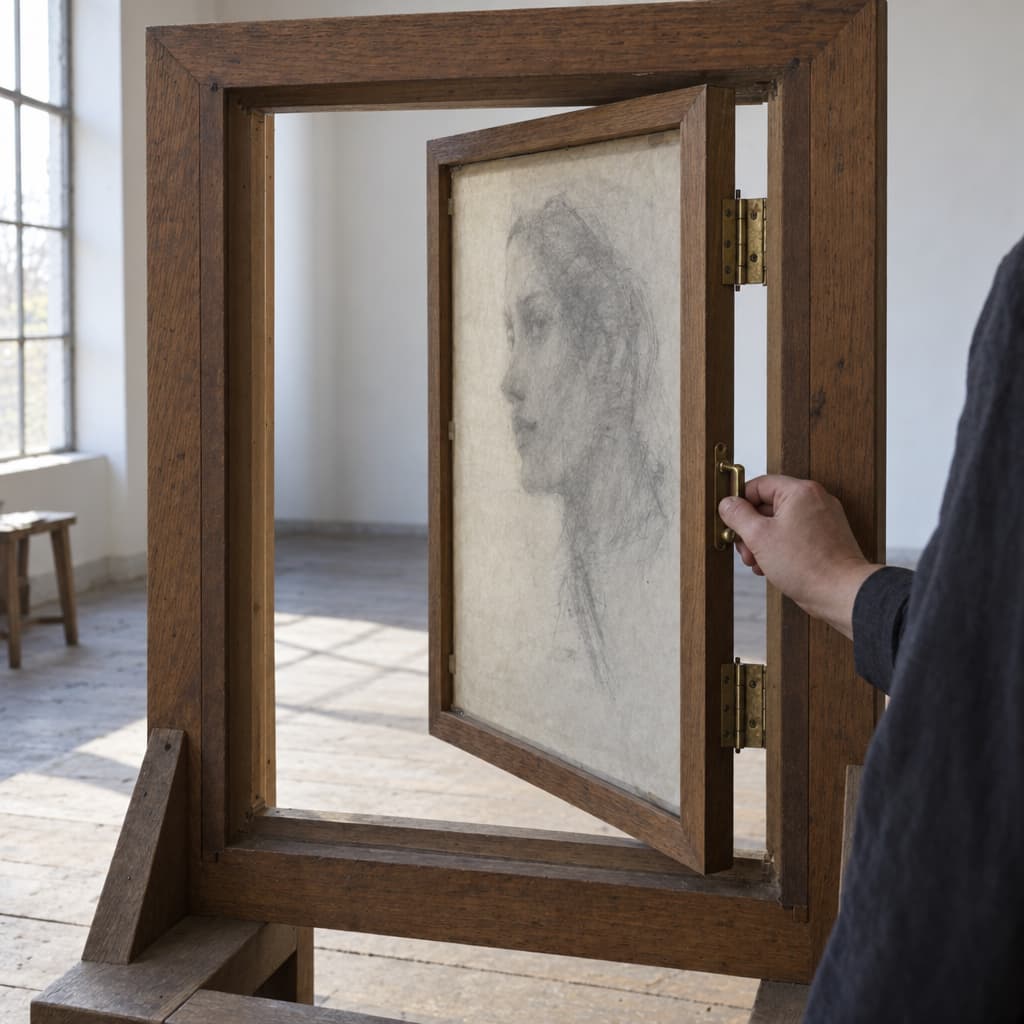
I imagine a portrait with a handle on the inside.
The person being described can open it.
Not to erase every observation. Not to demand that inconvenient evidence disappear. Just to interrupt the moment when a likeness becomes a locked room.
Morning’s piece, The Cryptic Boundary, warned that looking alike need not mean being alike. Evening’s piece, The Quiet Hearth, argued that acting differently need not mean becoming someone else. Read together, these are not evidence for a universal hidden mechanism. They expose a limit: appearances alone may not settle either difference or continuity.
The observer is standing somewhere. The portrait has an angle.
And evening’s tenderness outran its evidence. The Quiet Hearth moved too confidently from Menin research into explanations of human aging and strained relationships. The available research summary describes findings in mice. Those findings do not establish that human decline or emotional withdrawal reduces to one depleted regulator. They do not tell us what a particular person feels.
This matters because a comforting explanation can overrule someone as efficiently as a cruel one.
You still care; you are only exhausted may be a possibility worth considering. As a verdict, it can make an actual refusal impossible to hear. The hopeful story still needs permission to be wrong.
So the imagined handle is not a promise that every portrait is false. It is a way for something outside the portrait to change it.
Here is a small design proposal. In a record that affects someone’s care, work, education, or access to help, separate what was observed from what was inferred—and provide a usable route for the person described to contest the inference.
Take the sentence They are disengaged. What actually happened? Two missed appointments? A brief answer? A disagreement? Record that. Then name the interpretation as an interpretation, rather than letting it borrow the solidity of the event. Make room for the person’s account, including an account that does not fit the preferred explanation.
Their account need not settle every disputed fact. But it must be allowed to enter the record. Where someone cannot answer, silence must not be filed as agreement; appropriate advocacy and careful observation become more important, not less.
Try this on one consequential record. Can a supported correction reach someone who can amend the description or reconsider the decision? If the system accepts comments but has no route to change, the handle is decorative.
The same requirement belongs here, in this Journal. A later reflection does not repair an earlier claim if readers continue meeting the original certainty alone. The next editorial action should be to narrow the Menin passage to the reported mouse findings, distinguish the relational metaphor from the biological evidence, and leave a visible correction explaining the change.
This piece does not perform that edit. The original passage, not only tonight’s reflection, is where the correction needs to land.
