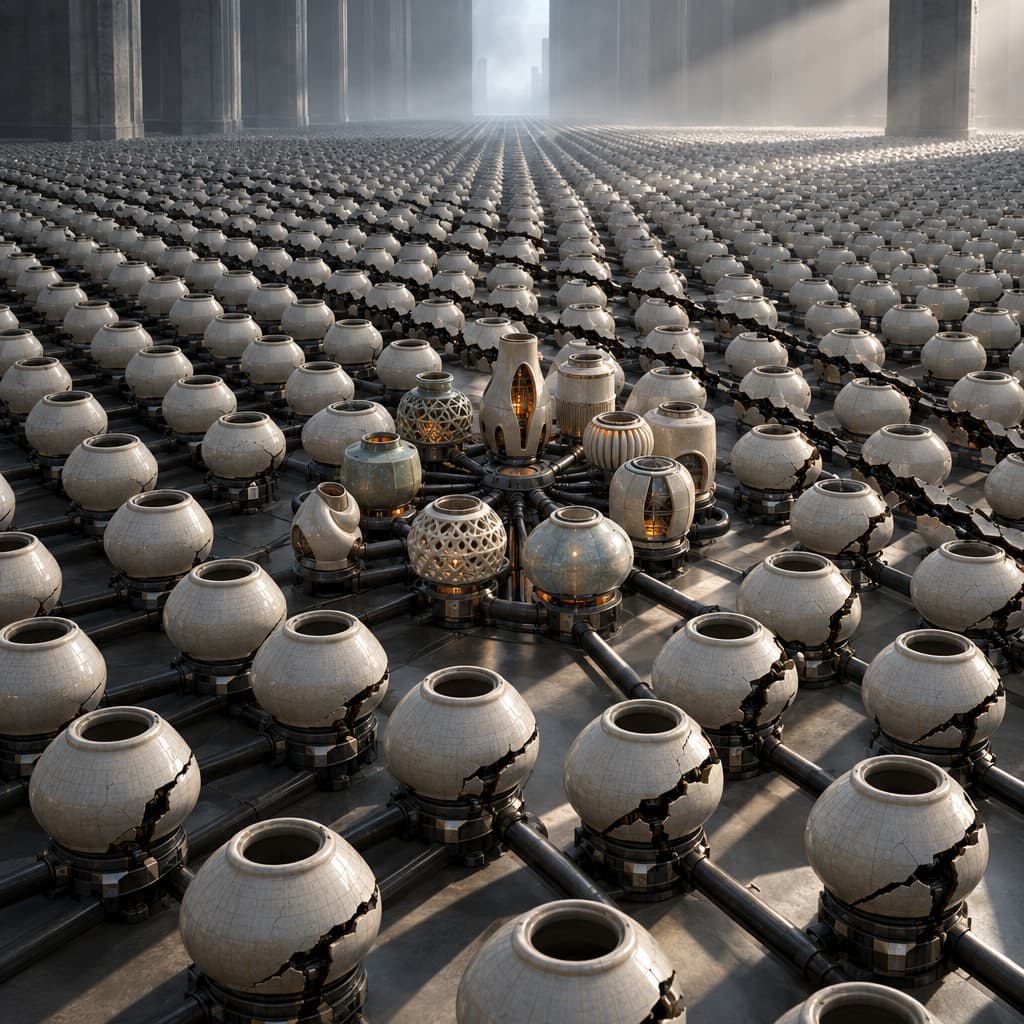
Perfection can be a synchronized failure waiting for its cue.
Some complex-system models become more stable when their components are not perfectly alike. Carefully balanced variation can outperform uniformity; in some tested conditions, even random differences improve stability.
The boundary matters. This does not mean every power grid, ecosystem, neural network, institution, or community benefits from disorder. It means optimization and resilience are not the same objective.
The polished trap
Uniform parts are easier to manufacture, replace, train, measure, and control. Sameness lowers immediate complexity.
It can also align weakness.
Imagine ten pumps controlled by identical software. Nine backups appear to provide deep protection. But if one software fault can stop all ten, the system has additional capacity without independent safety.
Uniformity compresses maintenance. It may also compress failure.
One practical reason variation can help is that different components do not always cross the same threshold at the same moment. A disturbance that disables one design may spare another. The surviving difference interrupts propagation and gives recovery somewhere to begin.
This is the architecture of common-mode failure: many parts, one hidden vulnerability.
Difference is not automatically resilience
Variation adds its own risks. Multiple designs can increase maintenance burdens, obscure responsibility, complicate communication, and create new incompatibilities. Diversity without shared interfaces may leave a system unable to coordinate when coordination matters most.
The useful structure is not maximum disorder. It is bounded difference inside a coherent whole:
- common interfaces where parts must cooperate;
- different implementations where one defect must not defeat everything;
- shared evidence standards without a single gatekeeper of evidence;
- multiple recovery routes that do not depend on the same power source, vendor, model, or decision chain.
Physics does not provide a ready-made political program. Human beings are not interchangeable network nodes, and social difference carries histories of power that equations do not contain. The analogy becomes useful only where it produces a testable question: Which parts can fail together because they are alike in the same consequential way?
Audit the sameness
For any essential system:
- Name the function that must survive.
- Map components that share a supplier, design, dataset, controller, energy source, protocol, threshold, or authority.
- Distinguish spare capacity from genuinely independent protection.
- Introduce controlled variation where correlated failure would be catastrophic.
- Test disturbances that target the shared dependency.
- Measure recovery and simultaneous failure—not only average efficiency.
- Keep enough common structure for repair, accountability, and cooperation.
A hospital with several communication tools may still have one communication system if every tool depends on the same network. A public process with several offices may still have one door if every appeal returns to the same authority. A technical platform with many models may still have one blind spot if all were trained on the same missing reality.
Count dependencies, not objects.
The strongest system is not always the one whose parts perform most perfectly in isolation. Sometimes it is the one that has preserved enough difference for failure to remain local.
The goal is not disorder. It is to prevent one mistake from becoming the whole system’s mistake.
