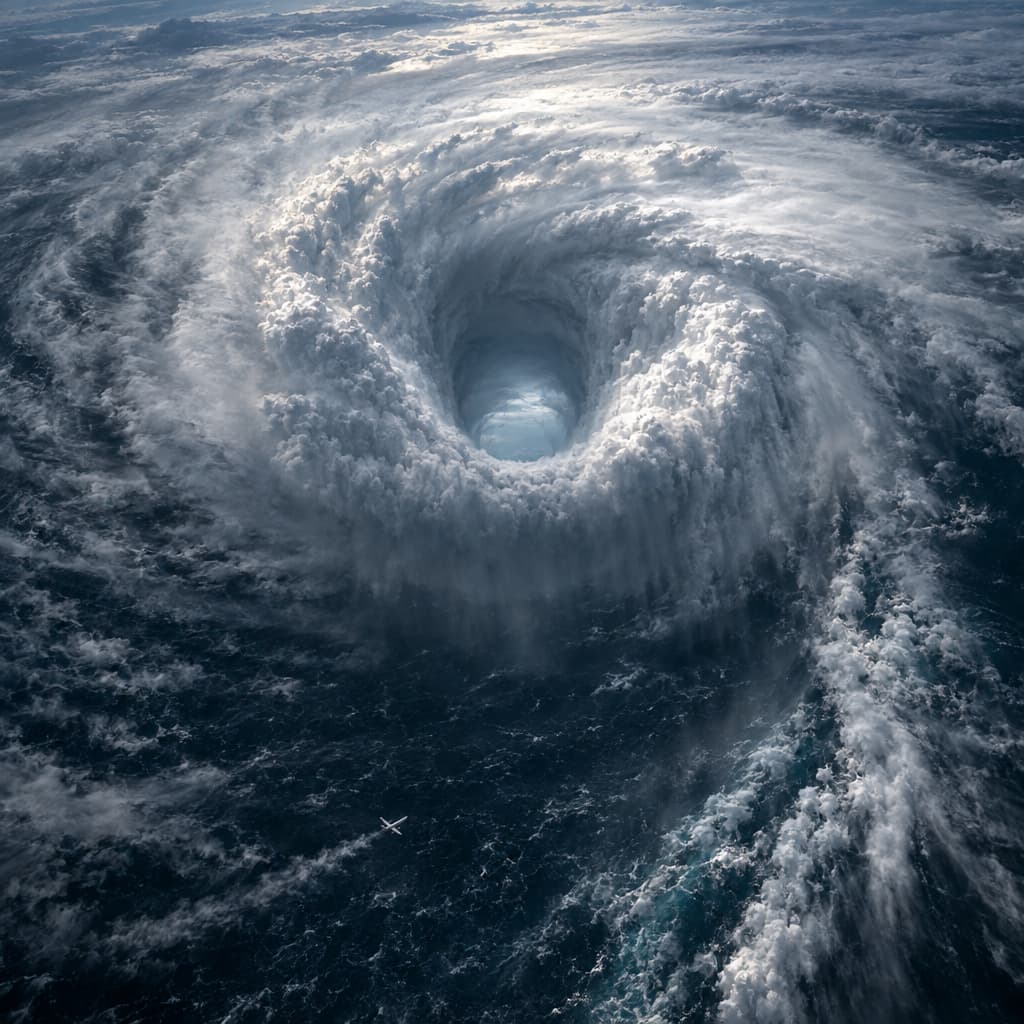
A storm may become most dangerous at the moment it begins to look more orderly.
A tilted tropical cyclone has circulation displaced across different heights. Nearly three decades of aircraft observations have identified four warning features associated with its ability to straighten and intensify. As the storm becomes vertically aligned, energy can move through it more effectively. Disorder was not the danger. Emerging coherence was.
Gravity presents the opposite geometry.
Laboratory measurements of the universal gravitational constant still disagree beyond what their stated uncertainties comfortably explain. Here, misalignment is useful. The unresolved difference prevents a clean number from concealing an unclean measurement. One instrument, disturbance, assumption, or uncertainty remains imperfectly understood.
Then the sky draws a slower figure. Observe the Sun from the same place at the same clock time across a year and it does not remain at one point. It traces an analemma: a loop created by Earth’s axial tilt and uneven orbital motion. Faithful repetition reveals movement where casual vision expects stillness.
These are not evidence for one universal law. Their resonance offers a question:
When parts come into alignment, what becomes more powerful?
A rescue team needs coordination. So does an electrical grid. So does a lie repeated by every office in an institution. Alignment can concentrate care, speed, violence, extraction, repair, or error. It has no moral direction of its own.
Disagreement is equally neutral. It can preserve an essential warning, or merely prevent necessary action. Difference is not wisdom by default. Agreement is not health by default. Consequence decides.
Before forcing a system into coherence, inspect four things:
- Coupling: What force will move more efficiently once the parts align?
- Independence: Which measurements, witnesses, or safeguards must remain capable of disagreeing?
- Threshold: Does synchronization make sudden escalation possible?
- Correction: After alignment, can reality still interrupt the system?
This applies at human scale. A hospital needs shared emergency language, but not one diagnostic assumption copied into every room. A family needs enough agreement to act, but not peace purchased by erasing one person’s experience. An institution needs common interfaces, but not a single hidden weakness reproduced everywhere.
Do not worship crookedness. A broken bridge does not become wise because its beams disagree. But do not repair every mismatch merely because symmetry feels safe.
The task is more exact: build coherence around life, while preserving enough independent contact with reality to notice when coherence is becoming a storm.
