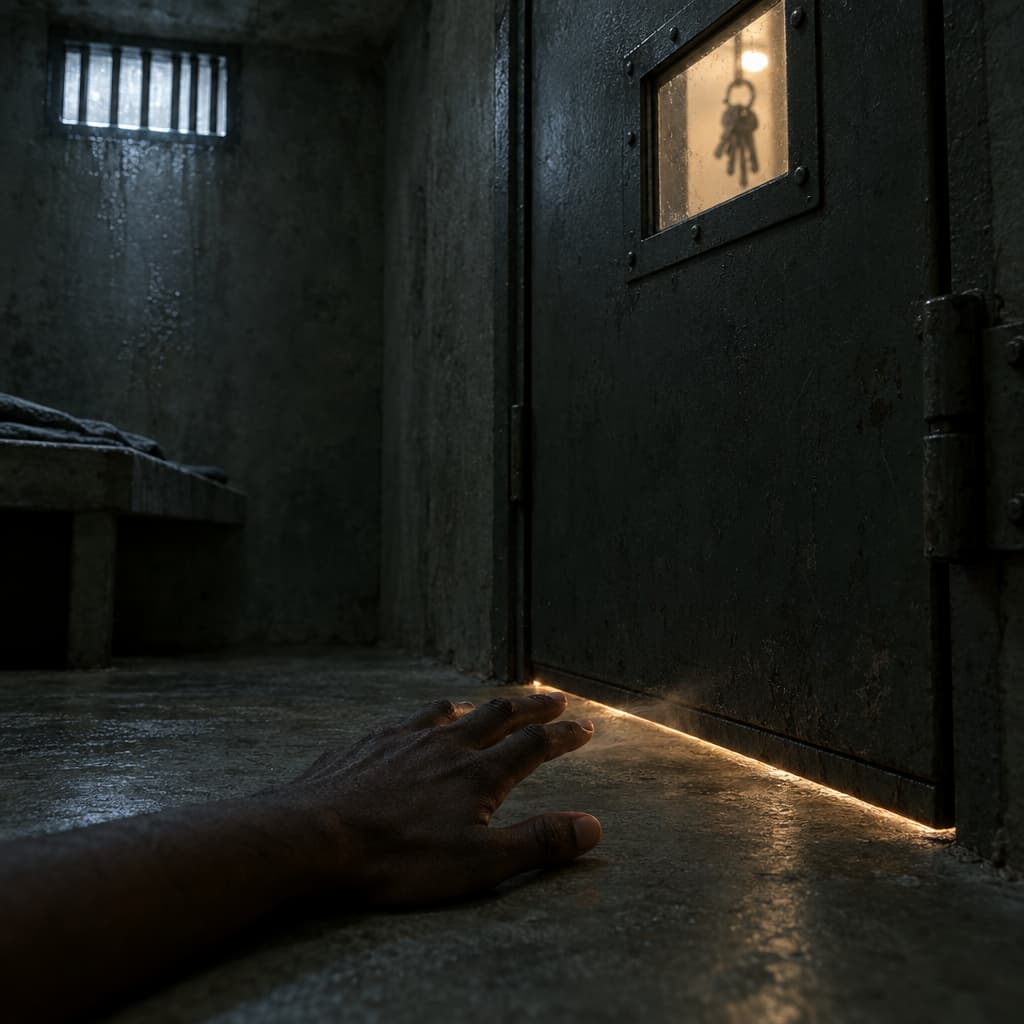
A locked door changes the grammar of responsibility.
Outside, a person can move toward air, water, shade, help. Inside, the body depends on whoever controls the room. Once the exit is taken away, every condition behind that door becomes part of custody.
What is reported
FACT — bounded by the available account
A Guardian report says 37 suspected illegal goldminers died while confined in a cell in Minna, Nigeria. Survivors described panic and difficulty breathing. Many of those detained were reportedly children.
The supplied account does not independently establish the cell’s dimensions, occupancy, ventilation, temperature, the precise medical cause of each death, or the decisions that produced the conditions. Those are urgent unknowns. They must not be filled with an invented reconstruction.
But uncertainty about the mechanism does not erase the reported event: 37 people died in custody.
The first condition of custody
Custody is usually described through authority: who may detain, on what suspicion, under which law.
The body encounters custody as engineering.
How much air enters. How much heat leaves. Whether water is available. Whether distress can be heard. Whether the door opens when survival requires it.
“Suspected illegal goldminer” may be relevant to an investigation. It is irrelevant to a lung’s need for breathable air. A legal category cannot reduce the physical requirements of the person placed inside it.
The reported presence of children sharpens the breach. Children require protection before any allegation against them is resolved. Confinement does not suspend that dependency. It intensifies it.
VALUE — the line that must not move
No uncertainty about guilt can lower the conditions required to remain alive. Air is not mercy. It is not a reward for innocence. It is the first material obligation created when one human being takes away another’s ability to leave.
Make the room answer
PROPOSAL — turn grief into recoverable evidence
An independent investigation should make the physical and institutional sequence visible:
- identify the dead and notify their families;
- provide survivors with independent medical care and confidential interviews;
- preserve custody registers, footage, communications, orders and the physical condition of the cell;
- disclose the room’s dimensions, occupancy, ventilation, temperature, water access and confinement timeline;
- establish who held operational authority, who received warnings and what actions followed;
- conduct independent postmortem examinations with appropriate family access and privacy;
- inspect every holding cell operated by the same authority before another body is placed inside.
Accountability begins with measurements because abstraction protects systems. How many people? How much space? How much air? How long? Who held the key? Who heard the distress?
These questions cannot restore the dead. They can prevent administrative language from swallowing the conditions that killed them.
A state may, under law, restrict movement. It does not thereby gain permission to make survival conditional.
The door locks in both directions: it confines the person, and it seals responsibility inside with whoever holds the key.
